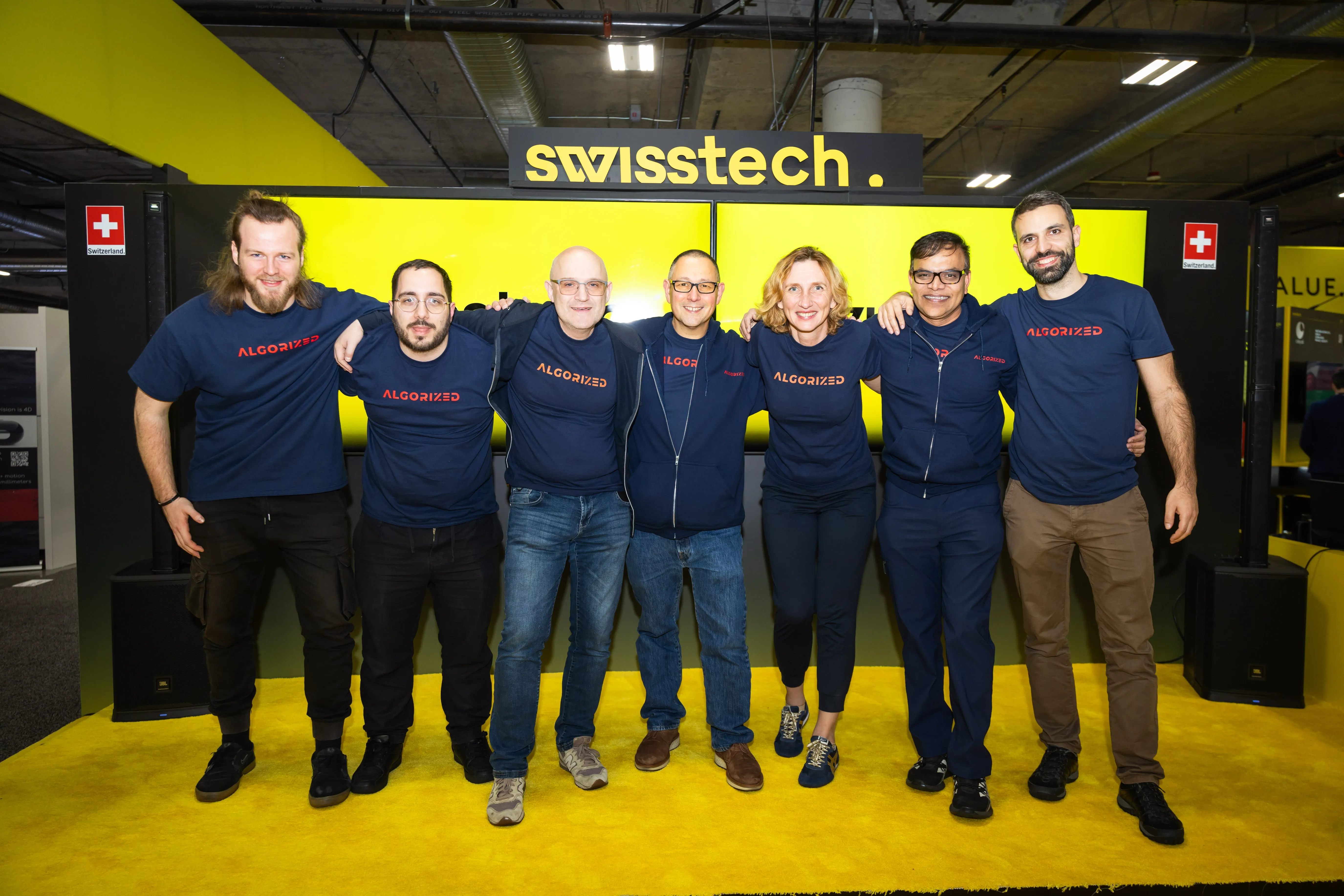
Algorized, a Swiss and Silicon Valley-based technology company building the intelligence layer for Physical AI, closed a $13M Series A financing round led by Run Ventures with participation from the Amazon Industrial Innovation Fund, Acrobator Ventures, and existing investors. This capital investment scales the Predictive Safety Engine, an edge-AI foundation model that utilizes wireless sensor infrastructure like Ultra-Wideband and Wi-Fi to perceive human presence and intent without relying on cameras. By digitizing environments through physics rather than pixels, the technology allows industrial robots to navigate complex spaces and see through obstructions like dust or darkness in real time.
Camera-Free Industrial Perception
The company focuses on eliminating the latency bottleneck in industrial automation, moving beyond traditional systems that force machines to stop whenever a human is detected. Following a successful debut with KUKA and ASUS at CES 2026, the funding will support commercial expansion across Europe and the U.S., focusing on Tier-1 manufacturing partners. This expansion aims to establish a new standard for human-robot collaboration where machines possess the "instinct" to operate safely at full speed in shared environments.
Faster, Safer Human-Robot Workflows
“The biggest bottleneck in Physical AI is the latency tax,” said Natalya Lopareva, CEO & Co-Founder of Algorized. “In a factory or a warehouse, a 100-millisecond delay can be the difference between a fluid workflow and a costly emergency stop. We’ve built an edge-native engine that gives machines the instinct to operate around people in real time. The goal is to ensure the line doesn’t stop because the intelligence is already there - on the floor, where it belongs.”
“Algorized is defining the category of Physical AI perception and predictive safety,” said PT Ungvichian, Partner at Run Ventures. “Most safety tech is an insurance policy; Algorized is a growth asset. By enabling robots to operate at full speed in shared spaces, they unlock billions in latent capacity. It’s rare to see a deep-tech solution with this level of immediate commercial ROI.”