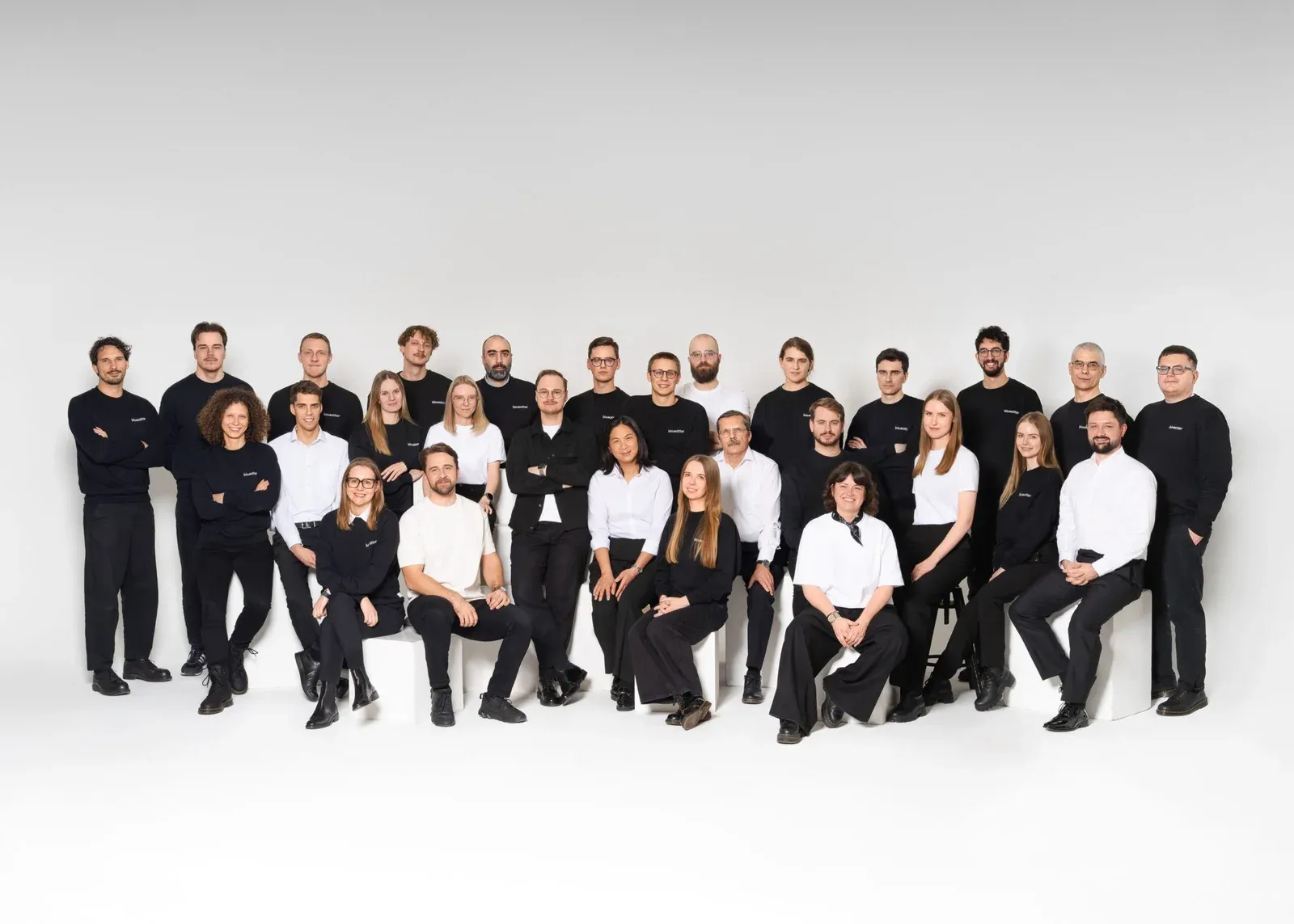
Vilnius-based Biomatter has raised $18 million in an oversubscribed Series A round to expand its AI-powered enzyme design platform and laboratory operations. The investment was led by Astanor, with participation from returning investors UVC Partners, Inventure and Metaplanet.
Founded in 2018 by Laurynas Karpus (CEO), Vykintas Jauniškis, Irmantas Rokaitis, Donatas Repečka and Professor Rolandas Meškys, Biomatter develops custom enzymes for applications in biopharmaceuticals, diagnostics, agriculture and industrial biotechnology. The company originated from research at Vilnius University’s Life Sciences Centre, where its founders began exploring how generative AI could be used to create functional proteins.
Biomatter has delivered more than 50 custom enzymes to over 25 enterprise customers across Europe, the United States and Japan. Its customers include AstraZeneca, BASF, Kirin Holdings, Neogen, Sanofi and Tereos, with several relationships developing into multi-year programmes involving multiple enzymes.
Designing Enzymes Beyond Natural Templates
Enzymes are biological catalysts used in processes ranging from pharmaceutical manufacturing to food production. Traditional enzyme engineering generally begins with a naturally occurring protein, which researchers modify to improve its performance or adapt it to a particular industrial application.
Biomatter takes a different approach, designing enzymes around the chemical reaction a customer needs to perform. Its AI models draw on a proprietary dataset of experimentally characterised enzymes, including structures and sequences that differ substantially from those found in nature.
The company combines computational design with laboratory testing, allowing it to evaluate whether newly generated enzymes perform the intended reactions. Results from these experiments are incorporated into its dataset to inform subsequent designs.
One example is a methylase developed for mRNA vaccine manufacturing that functions without S-adenosylmethionine (SAM), a cofactor required by naturally occurring methylases. According to Biomatter, the enzyme enables a reaction that does not occur naturally, potentially reducing dependence on an expensive input in certain manufacturing processes.
The company’s technology has also been incorporated into commercial products. Biomatter worked with Thermo Fisher Scientific to improve the oxidation resistance of Invitrogen SuperScript V Reverse Transcriptase, an enzyme used to convert RNA into DNA in molecular biology laboratories and mRNA research. The improvement contributes to reagent stability, supporting ambient-temperature shipping and storage at room temperature for up to six months.
Biomatter says its current development programmes can produce custom enzymes within weeks, compared with the months or years often required by conventional approaches.
$18M Series A to Expand Laboratory Capacity and US Operations
Biomatter will use the new funding to establish a 2,000-square-metre enzyme design and testing facility in Vilnius, scheduled to open in 2027. The site will bring more of the company’s experimental work in-house and increase its capacity to test AI-generated enzyme designs.
The company expects the additional laboratory infrastructure to shorten development cycles from weeks to days, allowing it to handle more customer projects while continuing to expand its proprietary enzyme dataset.
“Our goal is to make a custom enzyme as easy to order as a catalog product, including for reactions that don’t have one today,” said Laurynas Karpus, Co-founder and CEO of Biomatter.
Alongside the new facility, Biomatter plans to expand its commercial team and strengthen its presence in the United States, where approximately half of its customers are based. The investment will also support further development of its computational platform and the experimental data used to train its models.
The Series A follows a €6.5 million Seed round announced in August 2024, co-led by UVC Partners and Inventure, with participation from Metaplanet and Practica Capital. Biomatter also raised €500,000 in 2021 in an earlier financing led by Practica Capital.
Harry Briggs, Partner at Astanor, said the company’s ability to generate enzyme data beyond naturally occurring examples was central to the investment.
“Biomatter has spent years generating data beyond nature, which allows them to design enzymes that never evolved,” Briggs said.
The new laboratory is expected to open in 2027, providing additional capacity for Biomatter to develop and validate enzymes for customers across the pharmaceutical, agricultural and industrial biotechnology sectors.
