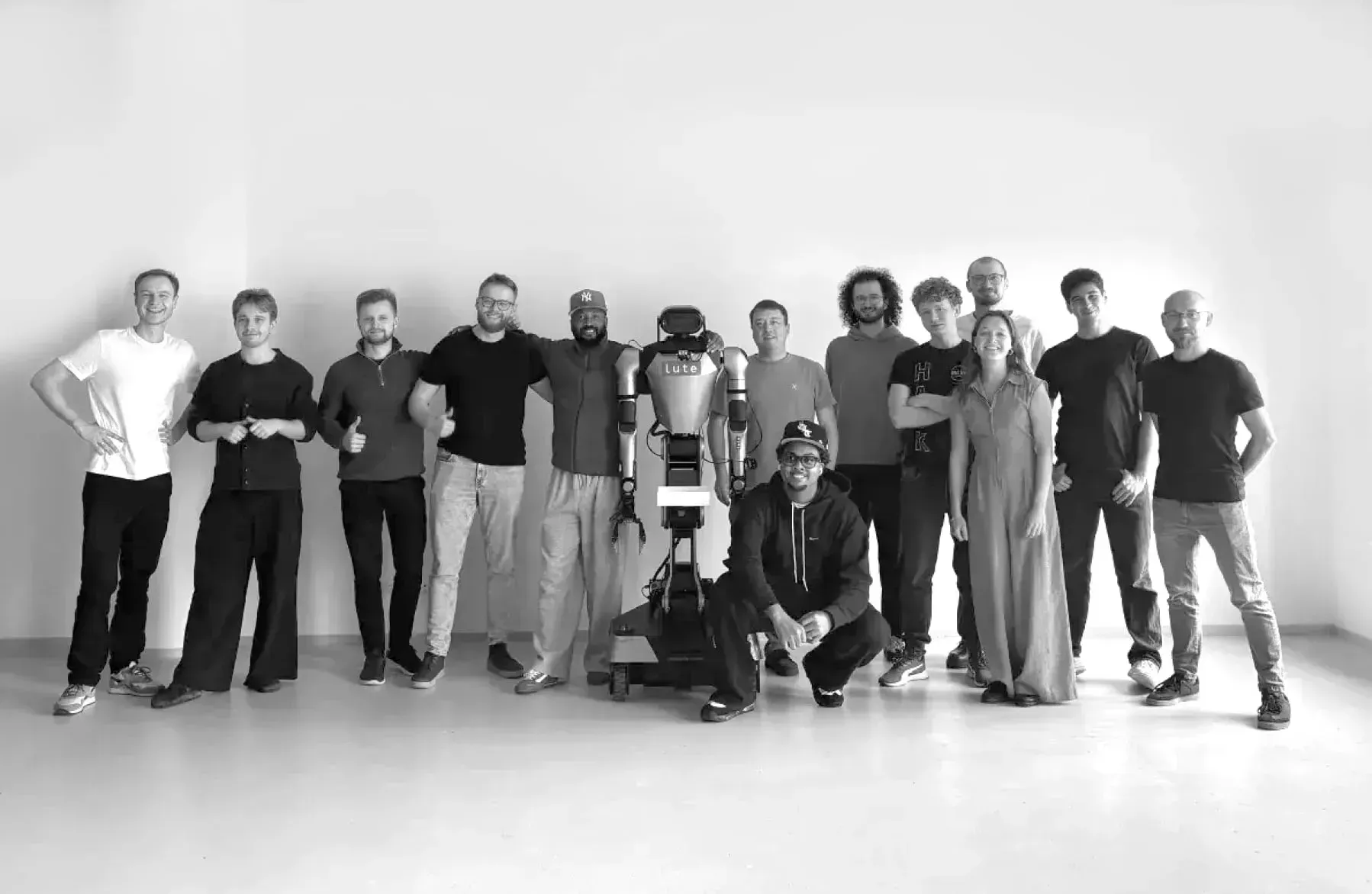
Physical AI startup Lute has raised $20 million across its Seed and Pre-Seed funding rounds. The Seed round was co-led by OTB Ventures and FORWARD.one, following a Pre-Seed round led by Credo Ventures and Seedcamp. Other investors include Inovo VC, Borusan Ventures, ff Venture Capital and angel investor Naval Ravikant.
Founded in January 2026 by Paweł Budzianowski and Krzysztof Walas, Lute develops robotics foundation models that incorporate tactile data alongside visual information. The company focuses on commercial applications across retail, warehousing and third-party logistics, with teams in Warsaw and San Mateo.
Combining Vision and Touch to Improve Robotic Manipulation
Most robotics AI models rely primarily on visual information, which allows robots to identify and locate objects but provides limited insight into physical contact, grip pressure or whether an object is beginning to slip.
To address this limitation, Lute has co-developed compact, elastomer-based tactile sensors with its partners and integrated them into a portable data collection system. This enables the company to collect tactile training data across different operating environments.
Alongside the funding announcement, the startup introduced Lute-0, its first video-action model. It combines wrist-camera footage, task instructions and tactile input to predict eight future video frames and the next 32 steps of robot movement.
According to Lute’s internal evaluations, the model was pre-trained using considerably less data than the open-source robotics model π0.5, with shorter training times and twice the latency performance. Lute-0 matched or outperformed π0.5 across all five tested retail manipulation tasks. Its success rate reached 98% when handling deformable snack products, compared with 70% for π0.5, and 76% in vegetable manipulation tasks, compared with 22%.
Lute-0 is the first in a planned family of foundation models trained on both tactile and visual data.
Scaling Commercial Robotics Deployments
Within ten months of its founding, Lute deployed its models at Europe’s largest automotive parts distributor and began working with major international retailers. The company is also partnering with robotics integrators to bring its technology to existing hardware, initially focusing on healthcare and manufacturing.
“Many system integrators want to deploy AI-driven robots, but few have the machine learning expertise to do it. Lute removes that barrier. It guides integrators without in-house AI teams through selecting the right hardware, defining the task and retraining the robot on site, so they can put physical AI to work for their customers,” said Kris Pałucki, Investment Director at OTB Ventures.
Lute’s deployment approach combines autonomous operation with monitoring and remote human assistance when required. Data collected from failures, human interventions and unfamiliar situations is incorporated into model training to improve performance in subsequent deployments.
“I hear the word ‘urgency’ in almost every pitch. With Lute team, you feel it as soon as you walk into their lab. That extreme sense of urgency put Lute’s models onto real retail and logistics sites within months, because every hour on the shop floor teaches a model something no lab can, especially through touch. In physical AI, the slow and the perfect will both lose,” said Boy de Jonge, Investment Manager at FORWARD.one.
The new funding will support large-scale data collection, further training and development of Lute’s foundation models, and deployments with additional customers. The startup is also expanding its research, engineering and deployment teams in Warsaw and San Mateo.