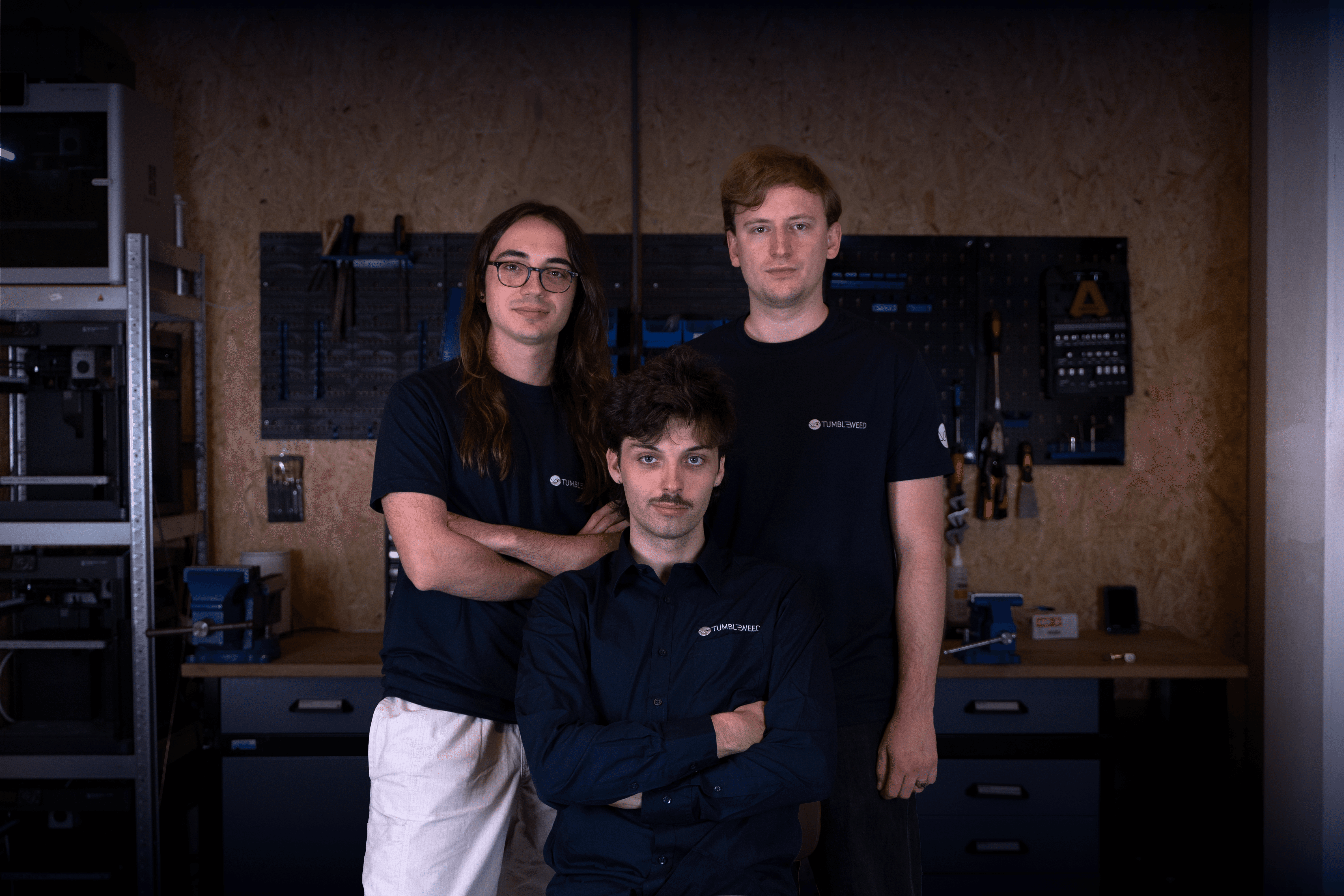
Vienna-based Tumbleweed has raised €6.9 million in seed funding to expand commercial access to microgravity research. The round was led by PactVC, with participation from Vanagon Ventures, existing investor Prototype Capital, EWOR and additional international investors and angel backers. More than one-third of the company’s 25 employees also invested personal funds in the round.
Founded in 2024 and led by CEO and Co-Founder Julian Rothenbuchner, Tumbleweed develops orbital platforms that allow research institutions and businesses to conduct experiments in space without building or operating their own satellites. The company has offices in Vienna, Austria, and Delft, the Netherlands.
Making Microgravity Research More Accessible
Conducting experiments in orbit typically requires extensive preparation, including the certification of equipment for spaceflight. Tumbleweed aims to simplify this process through its modular Pods, pre-certified payload containers that provide power and data connectivity for experiments carried aboard the company’s orbital platforms.
Customers can send their experimental payloads directly to Tumbleweed, which handles the spaceflight infrastructure and provides data collected during the mission. The company says its approach allows customers to launch experiments five times faster and at one-tenth of the cost of comparable experiments conducted through the International Space Station. Mission prices start at €15,000.
Tumbleweed demonstrated its technology with Oasis Alpha, launched on July 7, 2026, aboard SpaceX’s Transporter-17 mission. The satellite, described by the company as Austria’s first commercial satellite, carried experiments for four customers. According to Tumbleweed, the mission was fully booked a year before launch, with customers paying in advance.
The company built Oasis Alpha in nine months and says every customer it has served so far was conducting its first experiment in space. Since emerging from stealth earlier this year, Tumbleweed has expanded to a team of 25 across Austria and the Netherlands.
“This funding will allow us to scale what we’ve proven on our first mission, Oasis Alpha: that microgravity can be a widely accessible industrial resource,” said Julian Rothenbuchner, CEO and Co-Founder of Tumbleweed.
Funding Three Missions and Developing Oasis Beta
The €6.9 million seed round will finance three additional orbital missions in 2027, expected to carry experiments for more than 10 customers. Tumbleweed says the upcoming missions are already attracting bookings from laboratories working in medical research, biotechnology and agricultural technology.
The investment will also accelerate development of Oasis Beta, the company’s next-generation orbital platform scheduled for 2028. Unlike the initial Oasis Alpha mission, Oasis Beta is designed to accommodate larger payloads and provide re-entry capabilities, allowing experimental samples to be returned safely to Earth for further analysis.
The ability to recover physical samples could expand the range of research conducted through Tumbleweed’s platform, particularly in fields where scientists need to examine materials or biological samples after exposure to microgravity.
Daniel Dippold, CEO of EWOR, commented on the company’s progress:
“Tumbleweed put Austria’s first commercial satellite in orbit in less time than it usually takes to certify a single experiment. Julian has done exactly what he told us he would do when we first met him, only faster. Now every lab and manufacturer can use space without becoming a space company first.”
Andreas Klinger, Founder of Prototype Capital, also highlighted the company’s approach to reducing the preparation required for orbital research, allowing laboratories and manufacturers to focus on their experiments rather than developing spaceflight infrastructure.
With bookings open for both its 2027 missions and Oasis Beta, Tumbleweed plans to expand its commercial operations while developing the infrastructure needed to make microgravity experiments more accessible to industrial and scientific customers.
