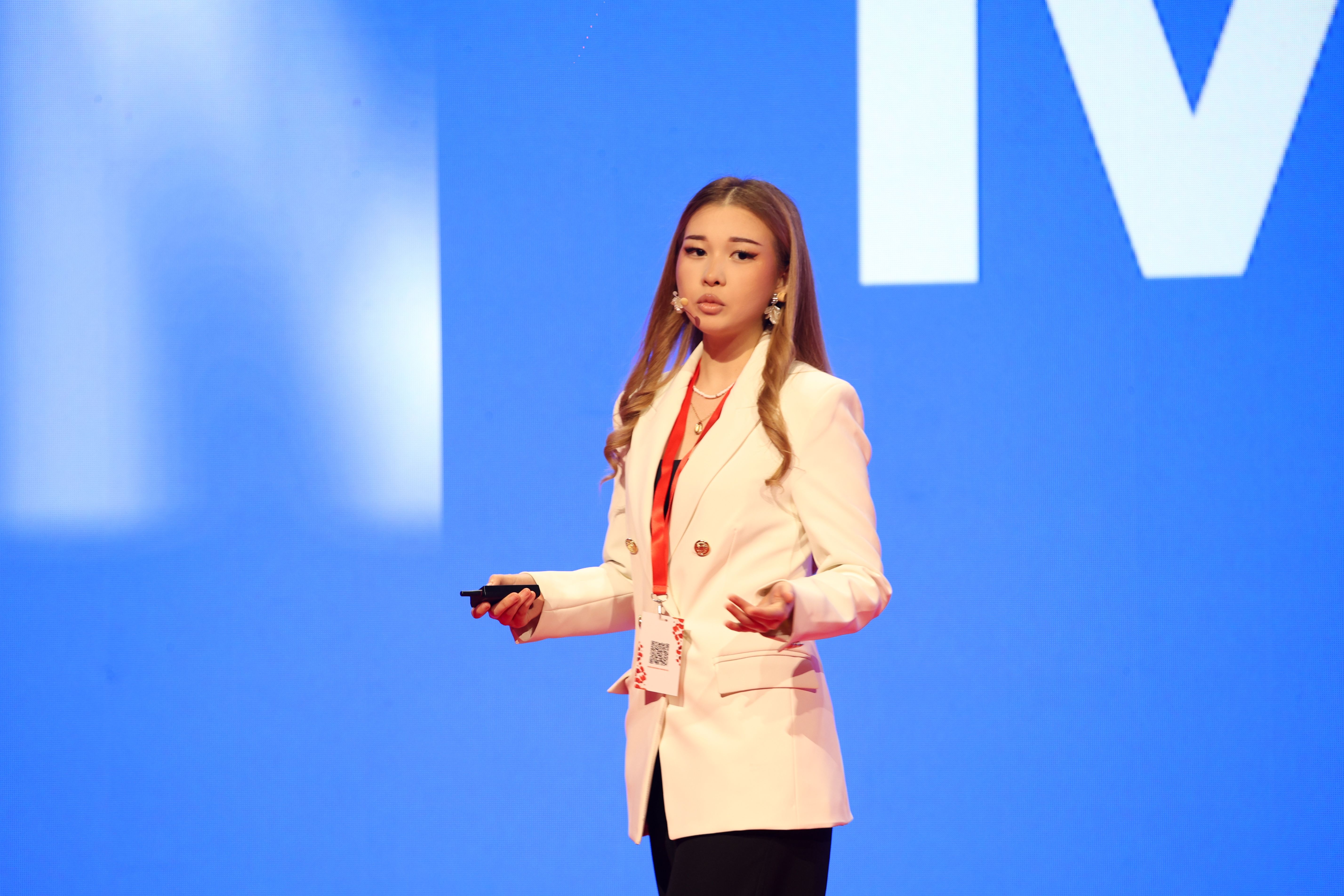
When both of Ukili Omarova’s grandparents suffered strokes, their speech changed so much that family members struggled to understand them. Years later, while studying speech impairments, she returned to a question that had stayed with her since childhood: if technology can translate between different languages, could it also help people understand someone with a speech impairment?
At 15, Ukili began developing Soile AI, a Kazakhstan-based startup building speech recognition technology for people with conditions such as cerebral palsy, Parkinson’s disease and post-stroke speech impairments. Now 17, she has been named among the Top 100 Female Founders to Watch by the Aurora Tech Award and is a winner of The Top Voices Tech Impact Awards 2025.
In an interview with Eva Lanina for The Top Voices’ interview series in partnership with the Aurora Tech Award, Ukili discussed her experience building an AI startup as a teenager, working with medical specialists and developing technology for languages that lack dedicated speech datasets.
From a Family Experience to an AI Startup
Ukili began working on scientific research projects at the age of 11, exploring subjects ranging from agriculture and astronomy to education and physics. She was particularly interested in finding practical applications for her research, which eventually led her to study speech impairments and revisit her grandparents’ experience.
“The idea for Soile did not start with me thinking ‘I want to build a startup’. It started with a personal story.”
The first version of Soile AI included speech rehabilitation exercises, consultations with medical specialists and speech recognition. As Ukili developed the product and consulted doctors, she realised that speech recognition was the part of the project she wanted to pursue further. She removed the other features and concentrated on building a translator.
During the interview, Ukili demonstrated how the technology processes recordings of people with cerebral palsy, converting their speech into text and a clearer audio version. In one recording, the speaker explained that they wanted to speak in their own videos rather than rely on software to read written text aloud.
Finding the First Users and Medical Partners
Without a background in medicine or experience running a company, Ukili initially relied on her own research. She then began searching for speech therapists and doctors on Instagram, asking them to assess the idea and help her understand the medical aspects of speech impairments.
“Sometimes you just need to find the first person who says: this is really important, let’s try.”
The first conversations led to introductions to other medical professionals who helped test the technology. Ukili also began working directly with people with speech impairments, some of whom agreed to share voice recordings and personal experiences to support product development.
Their participation helped her understand which features people actually needed and how changes to the product might affect its usefulness. As the number of users, specialists and potential partners grew, Ukili began treating Soile AI as a company rather than a scientific research project.
Building a Speech Dataset from Scratch
One of the biggest technical challenges behind Soile AI was finding suitable training data. According to Ukili, there was no existing database of impaired speech covering the languages of the Commonwealth of Independent States (CIS) that she needed to develop the technology.
“You can create a technically strong model, but if it’s trained on data that does not represent real users, it may perform poorly for exactly the people who need it most.”
Ukili began collecting recordings from people with different speech impairments. Soile AI has since accumulated more than 35,000 unique voice recordings, providing the team with data to develop its speech recognition technology across multiple languages.
The experience also influenced how Ukili approaches AI development. When asked whether she would prioritise a better AI model or better training data, she chose data. For a product designed around speech differences, she considers the representation of actual users in the training dataset particularly important.
Building a Healthcare Startup as a Teenager
Entering the healthcare sector at 15 meant that Ukili had to establish credibility with professionals who had considerably more experience than she did. Some questioned whether someone without a university degree could contribute to medical technology. She also faced periods when the project lacked the people, resources or expertise needed to move forward.
Her age, however, gave her a different perspective on what was possible.
“I simply did not know enough of the rules to limit myself in advance.”
Ukili acknowledges the importance of medical expertise and sees collaboration with specialists as essential to developing Soile AI. Participating in startup competitions and technology events has also helped her gain recognition and establish trust with potential partners.
Beyond recognition for her own work, Ukili uses these opportunities to draw attention to speech impairments. She hopes that presenting the project to wider audiences will encourage other researchers and entrepreneurs to investigate the problem and develop their own solutions.
Taking a Kazakhstan-Based AI Startup into International Markets
Ukili sees Central Asia’s strong technical education and growing interest in AI as advantages for young entrepreneurs. However, she believes the region still needs better access to international investors, technology infrastructure, commercial partners and global markets.
“Geography should no longer determine the scale of your idea.”
For Ukili, building an international company from Kazakhstan involves developing relationships beyond the local startup ecosystem. She has attended international technology forums and, at the time of the interview, was in China exploring its technology market and opportunities to collaborate with medical specialists.
Soile AI already works with several CIS languages, and Türkiye has recently been added to the project’s geographical coverage. Ukili also plans to collect speech datasets in China. Expansion into Europe and the US remains a longer-term consideration, particularly given the medical certification requirements she expects to encounter in those markets.
For Ukili, the success of Soile AI will ultimately depend on whether people with speech impairments can use the technology in their everyday lives, whether at work, in education or in conversations with their families.
Watch the full interview with Ukili Omarova on The Top Voices YouTube channel.