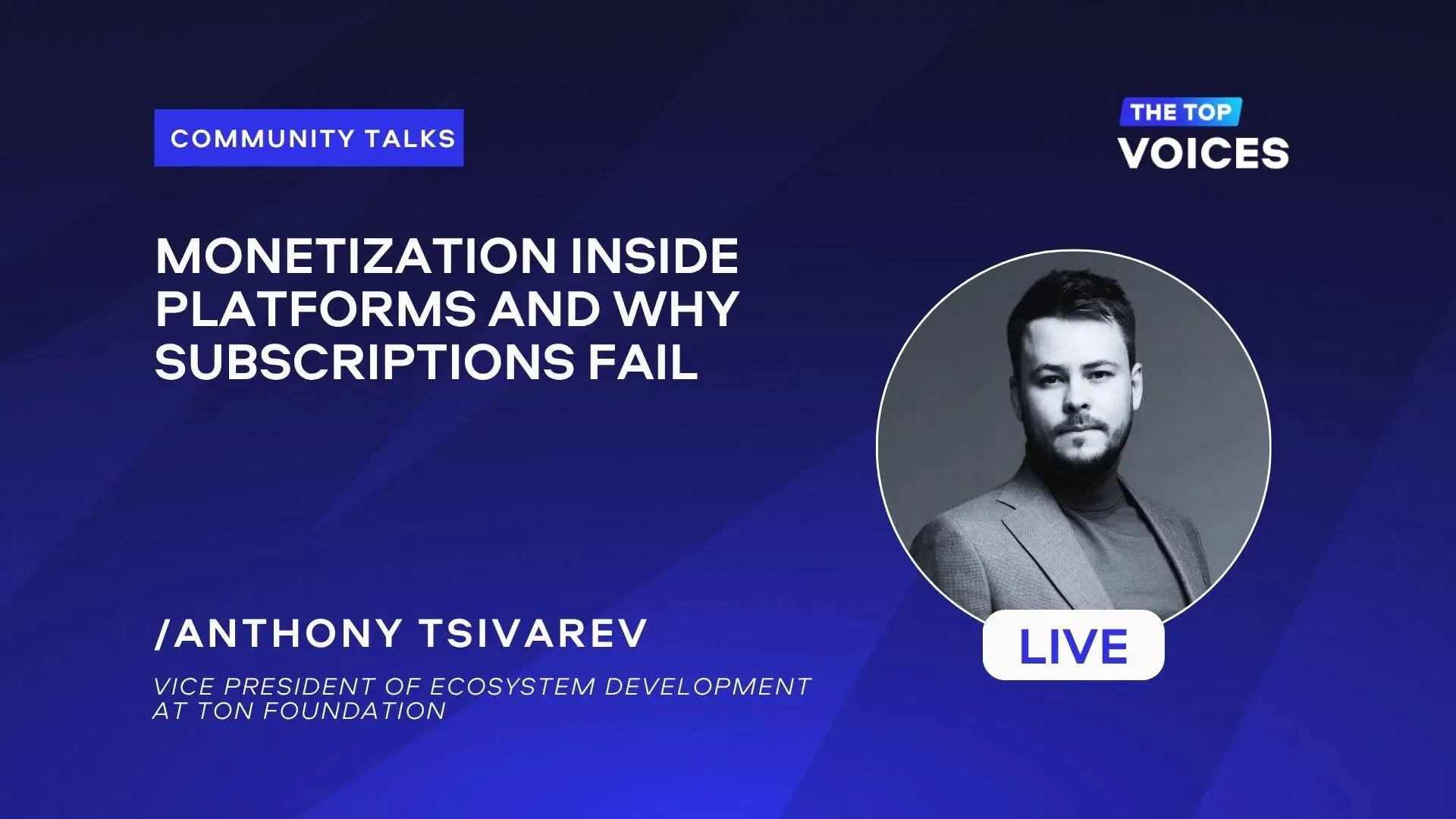
Many startups launch inside platform ecosystems expecting monetisation strategies from the App Store to work the same way. In reality, platform users behave very differently: they arrive with low commitment, short attention spans, and endless alternatives one swipe away. This webinar explores why subscription-first monetisation often fails inside platform ecosystems — and which models actually perform better.
Speaker
Anthony Tsivarev is Vice President of Ecosystem Development at TON Foundation, where he focuses on expanding the Telegram Mini Apps ecosystem and driving adoption among developers. Previously, he led the SuperApp direction at VK, where he launched the VK Mini Apps platform and helped bring multiple startups to market within the ecosystem.
Why Subscription Models Break Inside Platforms
Subscriptions assume a specific type of user behaviour: intentional product choice, repeated usage, and willingness to commit to ongoing payments. Platform environments work differently.
Users often arrive through shared links, chats, or recommendations, with little initial intent and low switching costs. In this context, asking for recurring commitment too early creates friction instead of conversion.
The key issue is simple: subscription models assume loyalty before trust has been earned.
Understanding Platform User Behaviour
Platform users behave differently from traditional app users.
A typical App Store journey involves active search, comparison, download, onboarding, and eventually payment. Inside platforms, the path is much shorter and less intentional: tap a shared link, spend a few seconds deciding whether the experience is worth attention, then leave or continue.
This dramatically changes monetisation strategy. Products cannot charge for commitment that users have not yet developed.
What Actually Works: Progressive Monetisation
A more effective approach is progressive monetisation — gradually increasing monetisation as engagement deepens.
This model typically follows four stages:
- free core experience to prove value and build habit
- microtransactions for low-friction impulse purchases
- premium layers for highly engaged users
- optional subscriptions only for the most loyal segment
Instead of monetising immediately, the focus shifts toward earning engagement first.
Why Microtransactions Perform Better
Microtransactions align much better with platform behaviour.
Small purchases require little decision-making, fit naturally inside active product usage, and provide immediate gratification. Because there is no long-term commitment, users are far more willing to spend on instant value than on recurring subscriptions.
Placing monetisation directly inside the product loop — rather than outside it — makes conversion significantly more natural.
The Power of Social and Cosmetic Spending
Not all monetisation is functional. In many platform ecosystems, users pay for identity, visibility, and social expression.
Cosmetics, badges, profile customisation, and limited items perform well because they enhance self-expression rather than restrict access. The key distinction is psychological: users should want to pay, not feel forced to pay in order to compete.
Competitive Monetisation Models
Competition creates strong monetisation mechanics.
Tournament-style models work because the value proposition is immediately clear: a small entry fee for a visible reward opportunity. These systems also create built-in virality, as competition naturally drives invitations, engagement, and repeat participation.
The principle extends beyond gaming into quizzes, prediction products, and community competitions.
Why Ads Are a Weak Primary Model
Advertising inside platform ecosystems comes with structural disadvantages.
Interruptive ads break session flow, static placements are often ignored, and every impression competes directly with users returning to their chats. Revenue per user is often significantly lower than in traditional mobile apps.
Ads can still work when integrated naturally — such as rewarded experiences or branded content — but relying on ad revenue alone creates a fragile business model.
Payments as a Hidden Growth Lever
Native payment infrastructure is one of the biggest platform advantages.
When payments happen inside the ecosystem — with stored wallets or one-tap flows — conversion improves dramatically. Every additional redirect or checkout step increases friction and reduces conversion.
Monetisation strategy is not only about pricing models, but also about payment design.
Building the Right Monetisation Stack
Strong platform products rarely rely on a single monetisation model.
Instead, successful products layer monetisation:
- free usage for all users
- microtransactions for active participants
- premium cosmetic or status layers
- competitive paid mechanics
- subscriptions only for the most engaged users
This creates a monetisation system that matches actual user behaviour rather than forcing traditional app economics onto platform-native products.
Conclusion
Platform monetisation requires a different mindset from traditional mobile products. Subscription-first strategies often fail because they assume a level of commitment that platform users have not yet developed.
The most effective products build trust first, monetise progressively, and align pricing with user behaviour inside the platform ecosystem.