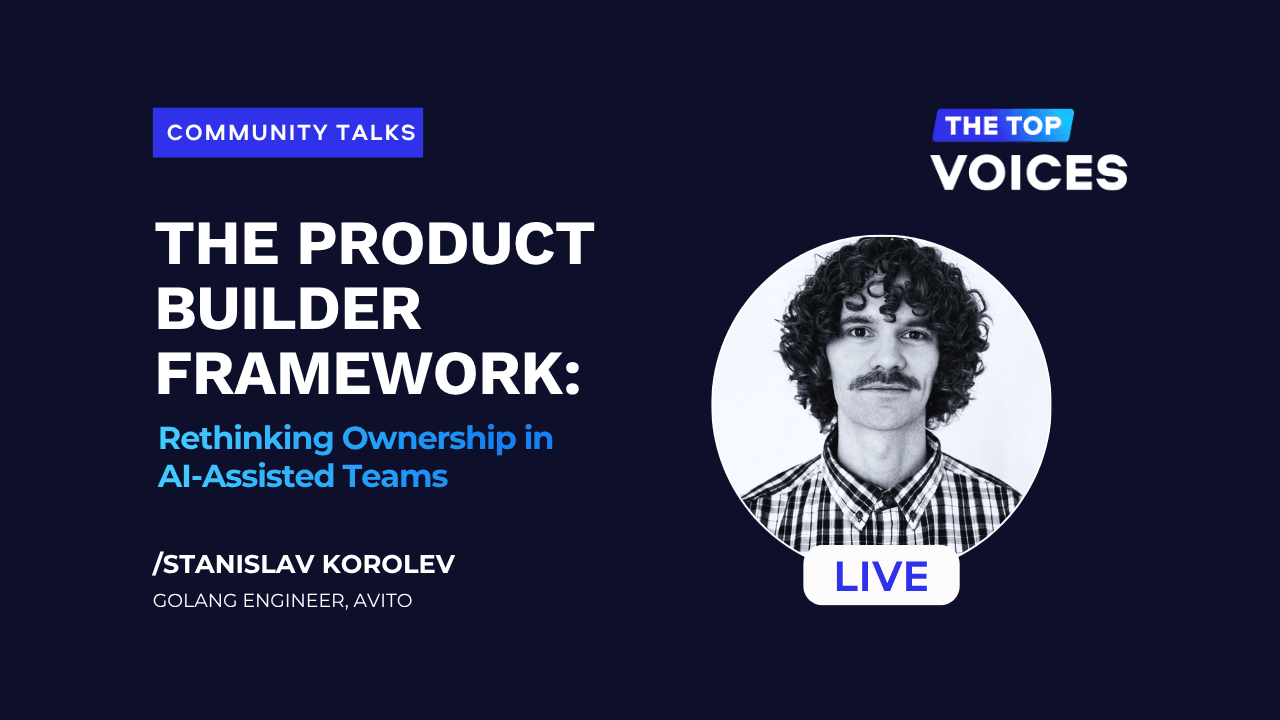
Artificial intelligence is transforming how quickly teams can build software, but faster development does not always lead to better product outcomes. Even when AI significantly reduces coding time, projects can still slow down because of handoffs, unclear responsibilities, and lengthy decision-making processes. This webinar explores a new approach to product development: the Product Builder Framework, where individuals take ownership of customer problems from initial discovery through implementation and measurable results.
Speaker
Stanislav Korolev is an AI Builder with a background in backend engineering, high-load systems, and distributed architectures. His experience includes large-scale classifieds platforms, logistics, and fintech, with systems handling up to 100,000 requests per second on a single endpoint.
Why Faster Coding Doesn’t Mean Faster Product Development
AI-powered development tools have dramatically accelerated software creation, but coding represents only one part of the product development lifecycle.
Traditional workflows involve multiple stages, including discovery, design, development, testing, launch, and evaluation. Even when AI reduces implementation time, teams may still spend significant time waiting for decisions, approvals, or input from other departments.
The challenge is therefore not simply to write code faster but to improve how teams move from identifying customer problems to delivering measurable outcomes. This requires looking beyond individual engineering tasks and reconsidering how responsibilities are distributed across the entire product lifecycle.
From Task Execution to End-to-End Ownership
The Product Builder Framework proposes a shift from fragmented responsibilities toward continuous ownership of customer problems.
Instead of focusing exclusively on implementation, a product builder follows the entire process: understanding the problem, testing assumptions, building solutions, measuring results, and deciding what happens next.
This approach does not eliminate traditional product roles. Product leads continue to define strategic goals, budgets, and business constraints, while builders gain autonomy to explore and implement solutions within agreed boundaries.
Specialists in design, data, engineering, and quality assurance remain essential, providing expertise when needed. The difference is that the builder maintains context and accountability throughout the process, reducing unnecessary handoffs and keeping decisions connected to customer outcomes.
Testing Solutions Before Scaling Them
A central principle of the framework is that teams should validate problems and solutions before committing significant resources.
For example, if new sellers abandon their first product listing, the builder begins by investigating why users leave rather than immediately developing new features. Funnel analysis and customer conversations help identify potential causes, while small prototypes allow teams to test assumptions.
AI can support research preparation, prototyping, and implementation, but customer evidence remains essential for making informed decisions.
Once a solution is ready, controlled releases and experiments help determine whether it improves the intended outcome. Teams must also monitor quality, technical risks, and other important metrics.
The goal is not simply to ship a feature but to generate evidence that supports the next decision: expand, revise, continue learning, or stop.
Introducing the Framework Through Small Pilots
Adopting broader ownership does not require reorganizing an entire company.
The framework recommends starting with a small pilot focused on one clearly defined customer problem. Teams should establish decision-making responsibilities, reserve time for expert support, and agree on success metrics before beginning.
An illustrative six-week pilot covers preparation, discovery, experimentation, controlled delivery, and evaluation.
Importantly, success should not be measured by development speed alone. Teams should also assess waiting time, decision-making efficiency, customer outcomes, product quality, and the total workload across builders and supporting specialists.
This allows organizations to evaluate whether broader ownership genuinely improves product delivery without creating additional risks or unsustainable workloads.
Conclusion
AI is changing not only how software is built but also how product teams can organize their work.
The Product Builder Framework suggests that the greatest opportunity lies in connecting customer problems, solutions, and measurable outcomes through clearer ownership.
Rather than optimizing individual development tasks, organizations can focus on reducing handoffs, enabling informed decisions, and creating faster learning cycles.
The future of AI-assisted product development may depend less on how quickly teams produce code and more on how effectively they turn customer needs into validated improvements.
