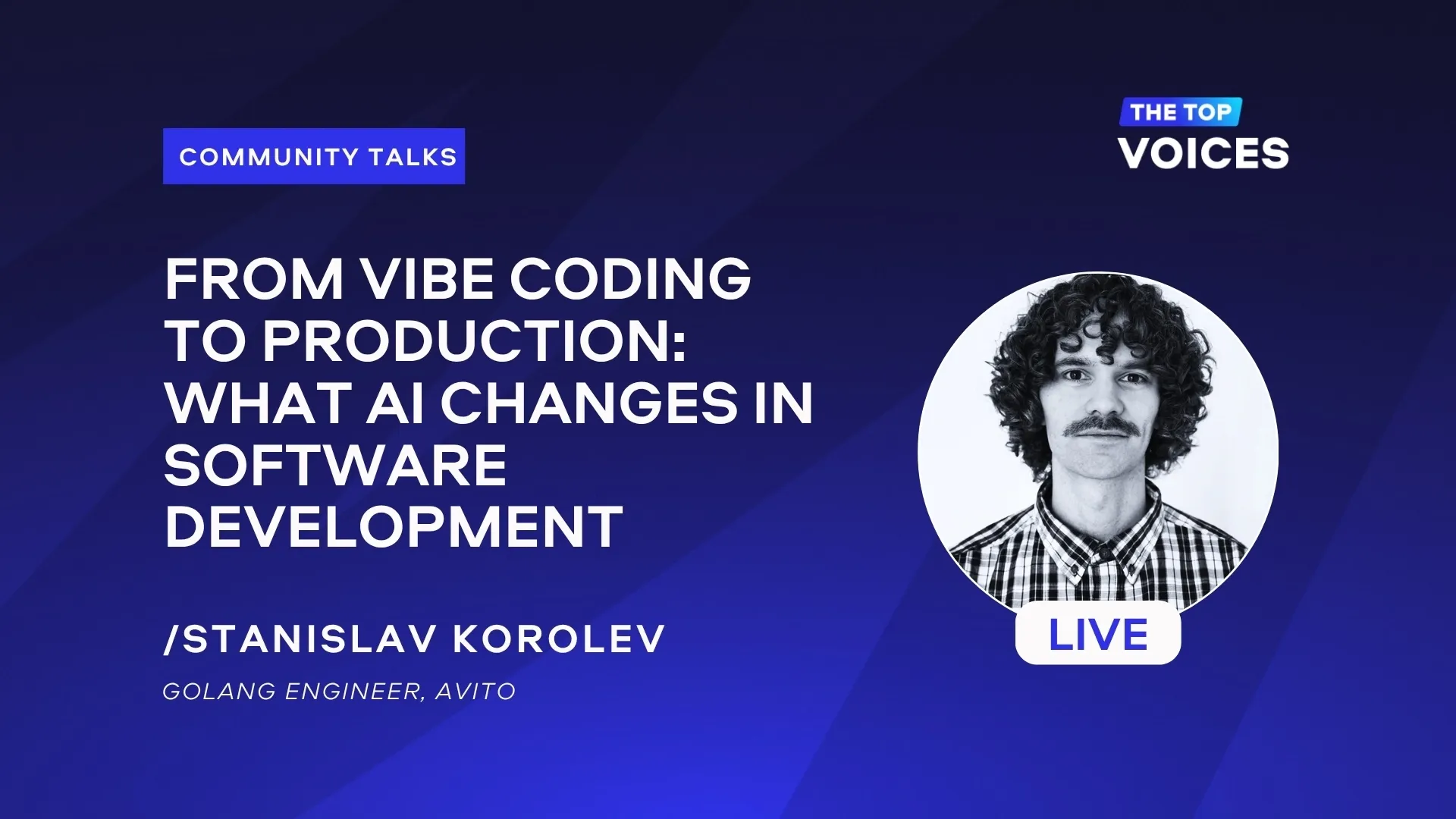
Artificial intelligence has dramatically accelerated software development, making it possible to build prototypes in hours instead of weeks. But as more AI-generated code reaches production, a different challenge emerges. The hardest part is no longer generating code—it is building software that remains secure, reliable, and maintainable over time. This webinar explores how software engineering is evolving beyond code generation toward designing environments where AI can consistently produce production-ready systems.
Speaker
Stanislav Korolev is a Golang Engineer at Avito, where he works on building scalable backend systems and focuses on practical observability approaches that help teams understand and operate their services in production.
From Writing Code to Building Reliable Software
AI has transformed how software is created, dramatically reducing the time required to build prototypes, MVPs, and early product iterations. However, writing code represents only one stage of software development.
As products move into production, engineering challenges shift toward reliability, security, maintainability, and long-term support. While AI can quickly generate functional applications, turning those applications into production-ready systems still requires careful engineering decisions and a deep understanding of the broader system.
Why Production Is Still Hard
AI significantly accelerates the first stages of development, but preparing software for production remains a fundamentally different challenge. Modern coding assistants can generate most of an application surprisingly quickly, yet the final stage requires substantially more engineering effort.
This is where edge cases, security, architecture, integrations, performance, and long-term maintainability become critical. AI makes it easier to build software, but not necessarily to build software that can safely support thousands of real users. Without understanding the entire system, even high-quality AI-generated code gradually accumulates technical debt and becomes harder to maintain.
From Prompt Engineering to Harness Engineering
As language models continue to improve, the role of engineers is shifting. Early AI adoption focused on prompt engineering—finding the best way to instruct a model. Later, the emphasis moved to context engineering, where success depended on providing the right project knowledge, tools, and memory.
Today, the focus is increasingly moving toward harness engineering. Rather than optimizing prompts, teams design the entire environment around AI agents, including documentation, automated validation, testing, observability, architectural constraints, and feedback loops. The better this environment is designed, the more reliably AI can operate over long, complex development tasks.
The New Role of Software Engineers
AI is not replacing software engineers—it is changing where engineering expertise creates the greatest value.
Instead of spending most of their time writing implementation details, engineers increasingly design architectures, define constraints, automate quality checks, and build systems that allow AI to make correct decisions independently. Success is becoming less about writing code faster and more about creating development environments where humans provide direction while AI reliably executes the work.
Conclusion
The future of software development is not about writing better prompts. It is about building better systems around AI.
Teams that invest in context, tooling, automated validation, and well-designed engineering environments will be able to scale AI-assisted development far more effectively than those relying solely on code generation. As AI becomes an integral part of engineering workflows, competitive advantage will come not from how quickly code is produced, but from how reliably AI can contribute to production software.