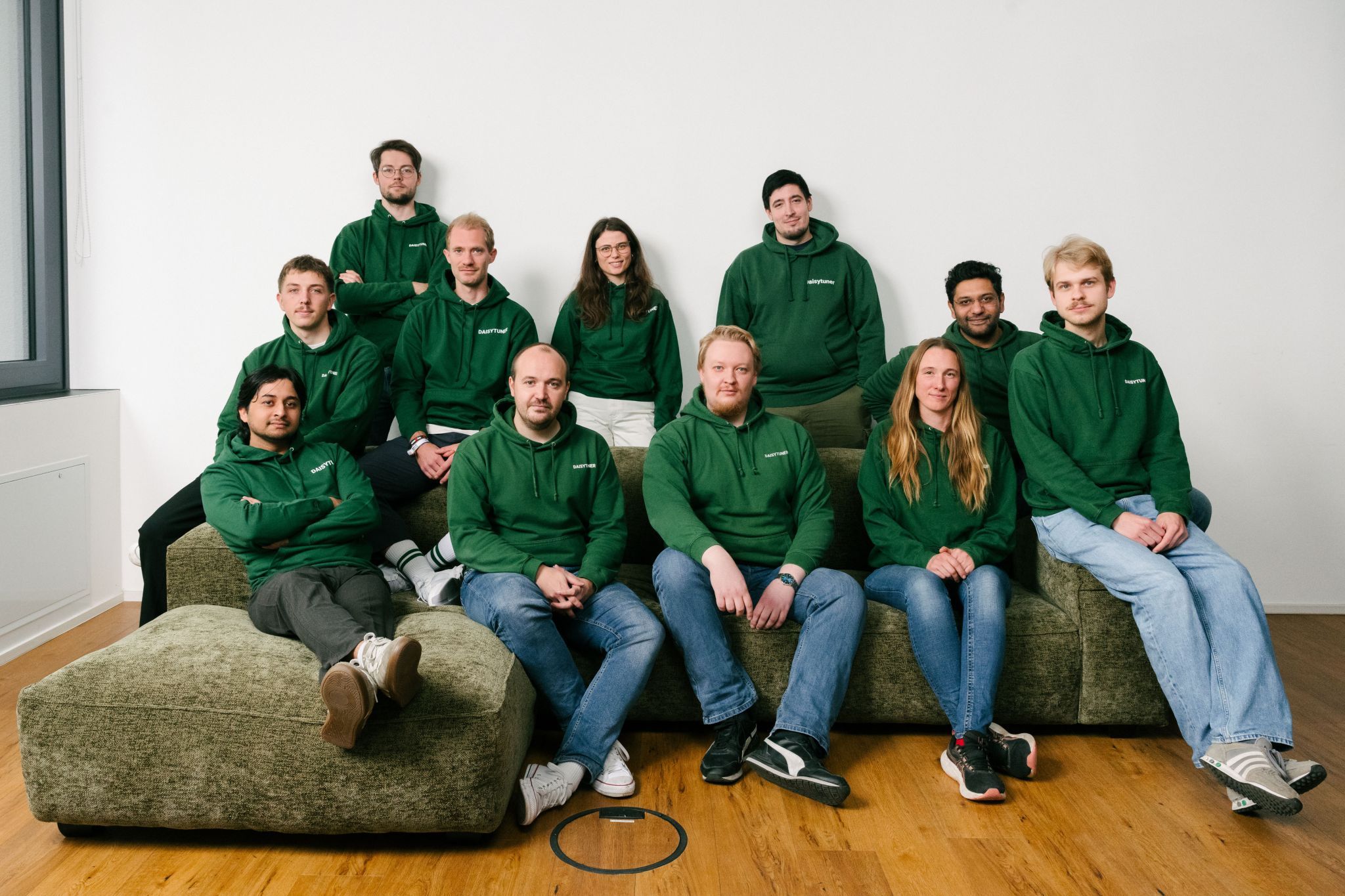
Darmstadt-based Daisytuner has raised €6 million in Seed funding and launched Daisyflow, an AI inference engine designed to run AI models efficiently across different types of computing hardware.
The round was co-led by Elaia and LEA Ventures, with participation from Amadeus APEX Technology Fund and Seedcamp.
Founded in 2024 by Lukas Trümper (CEO) and Adrian Schmitz, Daisytuner develops compiler technology that automates the process of adapting software to different processors. Its platform is designed to help companies improve the performance of AI models without having to manually optimise their code for each new chip.
The funding announcement coincides with the launch of Daisyflow, which brings the company’s compiler technology into production AI inference. The software supports language, vision, speech and recommendation models and can be deployed within a customer’s own infrastructure.
Automating AI Performance Across Different Chips
Running AI models efficiently requires software that can take advantage of the specific architecture of the processors executing them. As companies adopt new AI models and hardware, existing optimisations often need to be rewritten or adjusted, creating additional engineering work.
Daisytuner addresses this problem with its open-source compiler, docc, which translates code written in PyTorch, NumPy and C/C++ into a dataflow representation before generating native code for different hardware architectures, including NVIDIA CUDA and AMD ROCm.
The compiler works alongside AI agents that continuously search for performance improvements and benchmark them on physical hardware. Before an optimisation is applied, docc checks its correctness. Verified improvements are then stored in a performance database, where they can be reused for similar workloads.
Daisyflow builds on this technology by providing an inference engine for running AI models in production. It includes batching, routing and OpenAI-compatible APIs, allowing companies to integrate the software into existing AI applications.
Unlike services that require customers to run models through an external provider’s infrastructure, Daisyflow can operate within an organisation’s own environment, giving customers control over their data and computing resources.
According to Daisytuner’s initial benchmarks, Daisyflow ran the Qwen 2.5 model up to 18% faster than vLLM on AMD Instinct GPUs. The company has not published results demonstrating the same performance improvement across all supported models and hardware architectures.
Alongside Daisyflow, Daisytuner offers a hosted platform for compiling, benchmarking and optimising software, as well as a self-hosted enterprise version with additional security, compliance and service-level support.
€6M Seed Round to Support Enterprise Expansion
Daisytuner will use the new funding to bring Daisyflow to more enterprise customers, expand its team and extend its compiler technology to additional hardware architectures.
The company is targeting cloud providers operating different types of processors, enterprises seeking greater control over AI infrastructure and hardware manufacturers looking to make their chips compatible with existing AI workloads.
Its technology builds on more than a decade of compiler research, with a team that includes engineers and researchers from ETH Zurich, the Technical University of Munich, RWTH Aachen University, TU Darmstadt and Lawrence Livermore National Laboratory.
“Demand for AI compute is growing faster than any one chip generation can serve. The hardware to meet it is already out there, from established GPUs to a wave of new accelerators, but software keeps much of it on the sidelines,” said Lukas Trümper, Co-founder and CEO of Daisytuner.
The company is already working with chip vendors, European cloud providers and enterprises to improve the performance of AI workloads across different hardware platforms.
Sébastien Lefebvre, Partner at Elaia, highlighted the role of software compatibility in expanding access to computing resources.
“Daisytuner lets the same code run at full performance on the silicon you choose, without a rewrite,” Lefebvre said.
With Daisyflow now available, Daisytuner plans to expand its enterprise deployments while continuing to develop the automated optimisation technology behind its compiler.
